
How to Apply for a FSSAI Manufacturing License
Starting a food manufacturing business involves more than arranging machinery, purchasing raw materials, and preparing products for sale. Food manufacturers must also follow applicable food safety regulations to ensure that their products are safe, hygienic, and suitable for consumption. One of the most important legal requirements for food manufacturing businesses in India is obtaining the appropriate FSSAI License.
A FSSAI Manufacturing License is an essential authorization for eligible food manufacturing units involved in processing, producing, packaging, repacking, or handling food products. It helps businesses establish their credibility, follow food safety standards, and operate within the regulatory framework established under the Food Safety and Standards Act, 2006.
Whether you are planning to establish a new food processing unit, manufacture packaged food products, produce beverages, or expand an existing manufacturing business, understanding the FSSAI licensing requirements is important.
In this guide, we will explain what a FSSAI Manufacturing License is, who needs it, its benefits, the required documents, and the step-by-step application process. We will also discuss how Shugam Consultants can assist businesses with documentation, application filing, and licensing support.
What Is a FSSAI Manufacturing License
FSSAI Manufacturing License is a food safety authorization issued by the Food Safety and Standards Authority of India (FSSAI) through the designated licensing authorities. It allows eligible food manufacturing businesses to carry out their approved food-related activities in accordance with applicable food safety regulations.
FSSAI operates under the Ministry of Health and Family Welfare, Government of India. Its primary objective is to regulate food safety, establish standards, and protect consumers from unsafe or substandard food products.
Food manufacturing activities covered under FSSAI licensing include:
- Manufacturing and processing food products.
- Producing packaged and ready-to-eat foods.
- Processing dairy products and beverages.
- Manufacturing bakery and confectionery products.
- Producing edible oils and food ingredients.
- Repacking and relabelling food products, where applicable.
- Processing spices, grains, pulses, and other agricultural products.
The appropriate registration or license depends on the nature of the business, its production capacity, and the applicable eligibility criteria. Therefore, manufacturers should identify their correct licensing category before submitting an application.
Who Needs a FSSAI Manufacturing License
Any food business operator involved in manufacturing or processing food products must obtain the appropriate FSSAI registration or license before commencing operations, subject to the applicable regulatory requirements.
The following businesses commonly require a manufacturing license:
- Food Processing Units
Businesses involved in processing raw agricultural products, grains, pulses, fruits, vegetables, and other food ingredients into finished or semi-finished products.
- Packaged Food Manufacturers
Companies manufacturing packaged snacks, biscuits, namkeen, ready-to-eat meals, instant food products, and other packaged food items.
- Dairy Product Manufacturers
Businesses producing milk-based products such as paneer, cheese, butter, ghee, curd, and other dairy products.
- Beverage Manufacturing Companies
Businesses manufacturing packaged drinking water, fruit juices, soft drinks, flavoured beverages, and other non-alcoholic drinks.
- Bakery and Confectionery Units
Commercial bakeries and manufacturers producing cakes, bread, cookies, chocolates, sweets, and confectionery products.
- Spice and Edible Oil Manufacturers
Businesses involved in spice grinding, blending, edible oil processing, and manufacturing food ingredients.
- Private Label Food Manufacturers
Businesses manufacturing food products under their own brand names or producing products for other companies under contract manufacturing arrangements.
- Small and Large Food Manufacturing Units
Both small-scale and large-scale manufacturing businesses must identify the appropriate FSSAI category according to their activities and applicable eligibility conditions. A small business should not automatically assume that basic registration is sufficient simply because its production volume is limited.
Benefits of Obtaining a FSSAI Manufacturing License
Obtaining a FSSAI Manufacturing License offers several advantages beyond fulfilling a legal requirement. It helps manufacturers establish a structured food safety system and build confidence among customers, distributors, and business partners.
- Legal Authorization to Manufacture Food
The appropriate FSSAI license allows eligible businesses to conduct their approved manufacturing activities legally. It helps businesses operate in accordance with food safety laws and applicable licensing conditions.
- Builds Customer Trust
Consumers are increasingly concerned about food quality, hygiene, and product safety. An FSSAI license number on food packaging helps customers identify that the business is operating under the applicable food safety regulatory framework.
- Improves Business Credibility
Retailers, wholesalers, distributors, and institutional buyers may ask manufacturers to provide their FSSAI license details before establishing business relationships. Having the appropriate license can make these commercial discussions easier.
- Supports Business Expansion
A valid license can support manufacturers when they plan to expand production, enter new markets, or develop relationships with organised retail chains and online marketplaces, subject to the requirements of those channels.
- Encourages Better Hygiene Standards
FSSAI licensing requires food businesses to follow applicable hygiene and sanitary practices. This encourages manufacturers to maintain clean production areas, proper storage facilities, and suitable food-handling procedures.
- Helps Establish Brand Reputation
For businesses selling packaged food products, regulatory compliance is an important part of brand credibility. Proper licensing, food labelling, and quality control practices help create a more professional image.
- Supports Regulatory Compliance
The license helps manufacturers establish a compliance framework covering food safety, production practices, documentation, and other applicable regulatory obligations.
Documents Required for FSSAI Manufacturing License
Before applying for a FSSAI Manufacturing License, businesses should prepare the required documents according to their manufacturing activity and license category.
The exact document checklist may differ depending on whether the applicant requires a State or Central License. The following documents are commonly relevant.
Document | Purpose |
Applicant’s photograph | Identification of the applicant or authorised person |
Identity and address proof | Verification of proprietor, partners, directors, or authorised signatory |
Business registration proof | Establishes the legal constitution of the business |
Premises proof | Sale deed, rent agreement, or other acceptable proof of possession |
Manufacturing unit layout | Shows the premises, dimensions, and allocation of operational areas |
Machinery and equipment list | Details equipment, numbers, installed capacity, and horsepower |
Food product list | Identifies the food categories proposed for manufacturing |
Water testing report | Confirms the suitability of water used as an ingredient, where required |
FSMS plan | Explains food safety management and hygiene practices |
Authorisation letter | Identifies the responsible person authorised to manage the application or compliance matters, where applicable |
Additional documents may include:
- Partnership deed or proprietorship declaration.
- Memorandum and Articles of Association for companies.
- List of directors, partners, or proprietors with contact details.
- Form IX nomination, where applicable.
- Technical personnel details and qualification records, where applicable.
- Any additional documents required for the specific food category or manufacturing activity.
Important: A manufacturing unit should pay particular attention to its factory layout, machinery details, product categories, and water testing report. These are important parts of the manufacturing application. The official FoSCoS document checklist should always be checked before filing.
How to Apply for a FSSAI Manufacturing License
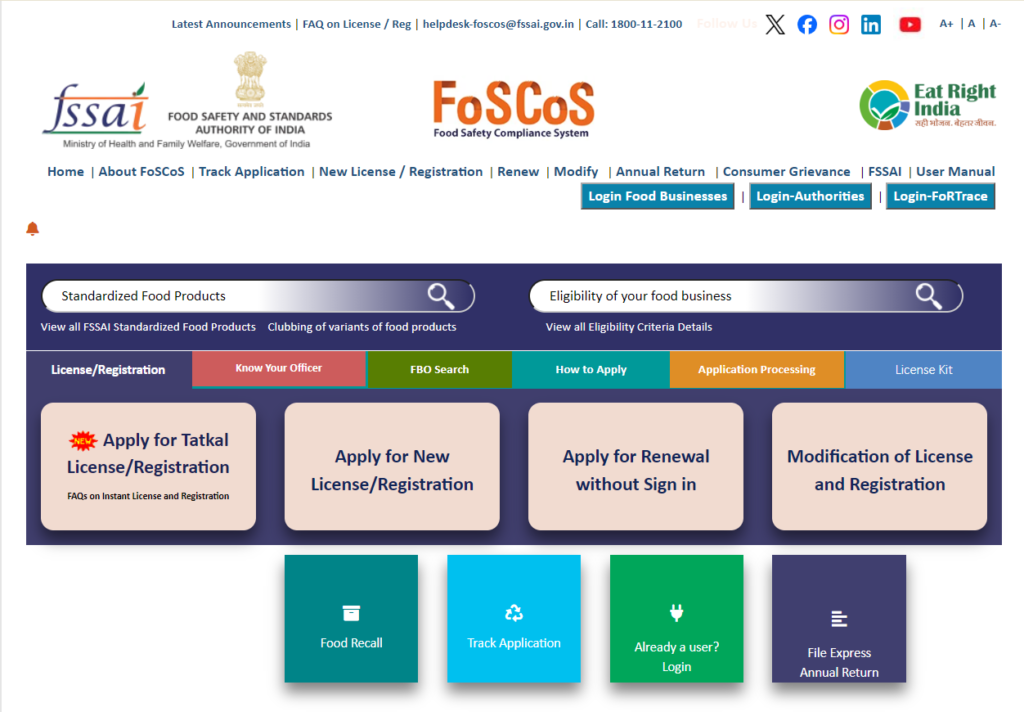
The FSSAI Manufacturing License application process is conducted online through the Food Safety Compliance System (FoSCoS) portal. Applicants can submit their details, upload supporting documents, pay the applicable government fee, and track the application status online.
Here is the step-by-step application process.
Step 1: Identify the Correct FSSAI License Category
The first step is to determine whether your manufacturing business requires a Basic Registration, State License, or Central License.
The applicable category depends on the business activity and the relevant eligibility criteria, including manufacturing capacity and other regulatory conditions.
Selecting the wrong category may result in application queries, delays, or rejection. Therefore, applicants should check the latest eligibility criteria before proceeding.
Step 2: Prepare Business and Manufacturing Details
Once the license category has been identified, collect the necessary business information.
This generally includes:
- Name and address of the manufacturing unit.
- Business constitution and applicant details.
- Nature of manufacturing activities.
- Food products proposed for manufacturing.
- Installed machinery and production capacity.
- Details of the authorised person.
- Manufacturing premises information.
Make sure that the information matches the supporting documents.
Step 3: Prepare the Required Documents
Arrange the documents according to the relevant FoSCoS checklist. Prepare the manufacturing layout, machinery details, food product list, and water analysis report wherever applicable.
It is advisable to verify the documents before uploading them to avoid incomplete submissions.
Step 4: Visit the Official FoSCoS Portal
Visit the official website:
FoSCoS – FSSAI Official Portal
Select the option to apply for a new license or registration. Choose the relevant state and the appropriate manufacturing category.
Step 5: Fill Out the Online Application Form
Complete the online application with the correct business and manufacturing information.
For licensing applications, the prescribed application is Form B. Enter the details of the applicant, manufacturing premises, food categories, and business activities carefully.
Review the application before proceeding to the next stage.
Step 6: Upload Documents and Pay the Government Fee
Upload the required documents in the specified format and complete the payment of the applicable government fee through the official portal.
The government fee depends on the license category and applicable fee schedule. Professional consultancy charges, if any, are separate.
Step 7: Application Verification and Inspection
After submission, the licensing authority examines the application and supporting documents.
If necessary, the authority may raise queries or request additional information. A physical inspection of the manufacturing premises may also be required to verify hygiene, sanitation, equipment, and other applicable food safety requirements.
Step 8: Receive the FSSAI Manufacturing License
Once the licensing authority is satisfied with the application and applicable compliance requirements, the license may be approved and issued.
After receiving the license, the manufacturer should check the business details, approved activities, food categories, and validity information mentioned on the certificate.
The license number should also be displayed and used as required under applicable food safety and labelling regulations.
Food Safety and Hygiene Requirements for Manufacturing Units
Obtaining a FSSAI Manufacturing License is not the end of the compliance process. Manufacturers must also maintain appropriate hygiene, sanitation, and food safety practices throughout their operations.
FSSAI requires applicable food businesses to implement a documented Food Safety Management System (FSMS) and follow the relevant requirements under Schedule 4 of the Food Safety and Standards (Licensing and Registration of Food Businesses) Regulations, 2011.
Important compliance practices include:
- Clean Manufacturing Environment: The production area should be maintained in hygienic conditions to minimise contamination risks.
- Proper Storage Facilities: Raw materials, packaging materials, and finished products should be stored under suitable conditions.
- Equipment Maintenance: Manufacturing machinery and food-contact equipment should be cleaned and maintained regularly.
- Employee Hygiene: Food handlers should follow appropriate personal hygiene practices and receive relevant training.
- Quality Control: Manufacturers should establish suitable quality checks to maintain food safety and product consistency.
- Pest Control: Appropriate pest management measures should be implemented to protect food products and manufacturing premises.
- Documentation and Records: Businesses should maintain relevant production, cleaning, quality control, and food safety records.
These practices help manufacturers maintain consistent product quality and prepare for regulatory inspections.
Common Mistakes to Avoid While Applying for a FSSAI Manufacturing License
Many applicants experience delays because of incorrect information or incomplete documentation. Avoiding these common mistakes can make the application process smoother.
- Selecting the wrong license category: Always check the applicable eligibility criteria before applying.
- Incorrect manufacturing capacity: Provide accurate production capacity and machinery information.
- Incomplete product details: Mention the correct food categories and manufacturing activities.
- Improper factory layout: Submit a clear layout showing the manufacturing and operational areas.
- Missing water testing report: Arrange the required water analysis report from an appropriate laboratory.
- Incorrect business information: Ensure that the business name, address, and applicant details match the supporting documents.
- Ignoring food safety requirements: Prepare the FSMS plan and maintain applicable hygiene standards before inspection.
Careful preparation can reduce unnecessary application queries and help avoid delays.
Why Choose Shugam Consultants for FSSAI Manufacturing License?
Applying for a FSSAI Manufacturing License involves several important steps, including identifying the correct license category, preparing manufacturing documents, completing the online application, and responding to regulatory queries.
For new manufacturers, understanding these requirements can sometimes be challenging. Shugam Consultants provides professional assistance to businesses seeking FSSAI licensing and related regulatory compliance support.
Here is how Shugam Consultants can help:
- Documentation Support
Get assistance in preparing and organising the documents required for your manufacturing license application, including business details, manufacturing information, and supporting records.
- Correct License Category Guidance
Choosing the appropriate license category is important. Shugam Consultants can help assess your business activity and manufacturing details to identify the applicable licensing requirements.
- Online Application Filing
Get assistance with completing the online application through the FoSCoS portal, entering business information, and uploading the required documents.
- Application Tracking and Query Assistance
If the licensing authority raises a query or requests additional information, Shugam Consultants can assist with understanding the requirement and preparing an appropriate response.
- End-to-End Approval Assistance
From initial documentation to application submission and follow-up, Shugam Consultants provides support throughout the licensing process.
Whether you are starting a new food manufacturing unit or planning to expand your existing food business, professional guidance can help you approach the licensing process with greater clarity.
Visit www.shugam.com to learn more about FSSAI licensing and business registration assistance.
Frequently Asked Questions About FSSAI Manufacturing License
- Is a FSSAI License mandatory for food manufacturers?
Yes. Food businesses involved in manufacturing or processing food products must obtain the applicable FSSAI registration or license before commencing operations, subject to the relevant eligibility requirements.
- Who can apply for a FSSAI Manufacturing License?
Proprietorships, partnership firms, LLPs, private limited companies, and other eligible business entities involved in food manufacturing can apply for the appropriate FSSAI license.
- What is the difference between a State and Central FSSAI Manufacturing License?
A State License and Central License are different licensing categories. The appropriate category depends on the nature of the food business and applicable eligibility criteria, including production capacity and other regulatory conditions.
- Can I apply for a FSSAI Manufacturing License online?
Yes. Applicants can apply through the official FoSCoS portal by selecting the appropriate manufacturing category, filling out the application, uploading documents, and paying the applicable government fee.
- Is a factory layout required for a FSSAI Manufacturing License?
Yes. A blueprint or layout plan of the processing unit is a required document for manufacturing and processing license applications. It should show the dimensions and allocation of operational areas.
- Is a water testing report required for food manufacturers?
A water analysis report from a recognised or public health laboratory is required for manufacturing and processing units where water is used as an ingredient, as specified in the applicable document checklist.
- Can I manufacture multiple food products under one FSSAI License?
Multiple food products may be covered under one license where permitted. However, the relevant food categories and manufacturing activities must be appropriately endorsed on the license.
- Can Shugam Consultants help with a FSSAI Manufacturing License application?
Yes. Shugam Consultants provides documentation support, application filing assistance, application tracking, and end-to-end licensing guidance for eligible food manufacturing businesses.
Conclusion
A FSSAI Manufacturing License is an important regulatory requirement for businesses involved in food production, processing, and manufacturing. It helps establish a legal foundation for food manufacturing operations while encouraging better hygiene, quality control, and food safety practices.
Before applying, manufacturers should understand their licensing category, prepare the required documents, verify their production details, and ensure that their premises meet the applicable food safety standards.
Although the online application process is accessible through the FoSCoS portal, selecting the correct category and preparing accurate manufacturing documents are important for avoiding unnecessary complications.
If you are planning to start a food manufacturing business or need assistance with an existing application, Shugam Consultants can help you with documentation support, application filing, and end-to-end approval assistance.
For professional guidance, visit www.shugam.com or contact the Shugam Consultants team to discuss your FSSAI Manufacturing License requirements.
Important Official Resources
For accurate and updated licensing information, refer to these official resources:
- FoSCoS – Online FSSAI Application Portal
- Documents Required for State License
- Documents Required for Central License
- FSSAI Licensing Regulations and Amendments
Regulatory note: FSSAI has published amendments to its licensing and registration regulations in March and June 2026. Applicants should verify the latest eligibility criteria, applicable thresholds, fee structure, and document requirements on FoSCoS before filing an application.
Leave a Comment
Have a question or suggestion? Share your thoughts below.