Partnership Firm Registration in Sonipat
Partnership Firm Registration is the process of officially recording a partnership firm’s details—such as its name, place of business, and partners—with the relevant Registrar of Firms. In India, this is done under Sections 58 and 59 of the Indian Partnership Act, 1932. In simple terms, and registration creates an official record of the firm and its partners. In India, registration is generally not compulsory, but an unregistered firm faces legal limits, including restrictions on bringing certain contract-related suits.
A partnership firm is a business run by two or more people who agree to share its profits and losses. The people are called partners, and they may all run the business or authorize one or more partners to act on everyone’s behalf.
The main types of partnerships vary by country. In general, they are general partnerships, limited partnerships (LPs), and limited liability partnerships (LLPs). If you mean India, the usual classifications under the Partnership Act are partnership at will and particular partnership; an LLP is a separate legal form.
Common types:
- General partnership: Partners typically share management, profits, and responsibility for the business’s debts. Personal liability is generally unlimited.
- Limited liability partnership (LLP): A registered form that generally gives partners some protection from personal liability for the business’s obligations or other partners’ actions. The details depend on local law.
Benefits of Partnership Firm Registration
- Easy to Expanded Capital & Credit: Multiple partners contribute funds, creating a larger capital base than a sole proprietorship. Banks are also more likely to approve loans due to the joint creditworthiness and personal guarantees of all partners.
- Diverse Skills & Synergies: Partners bring complementary talents—such as one managing operations while another handles sales—which leads to better management, balanced decision-making, and fewer managerial blind spots.
- Shared Financial Risk: Business losses, debts, and legal liabilities are distributed among all partners based on their agreed profit-sharing ratio, preventing the entire financial burden from collapsing onto a single individual.
- Minimal Regulatory Compliance: Setting up a partnership involves low legal costs, minimal paperwork, and no mandatory annual filings or public disclosure of financial audits, offering a high level of operational privacy.


Documents required for Partnership Firm Registration
1. Pan Card copy of all Partners
2. Aadhar card copy of all Partners
3. Photo of all Partners
4. Rent agreement copy of premises
5. Electricity bill copy of premises
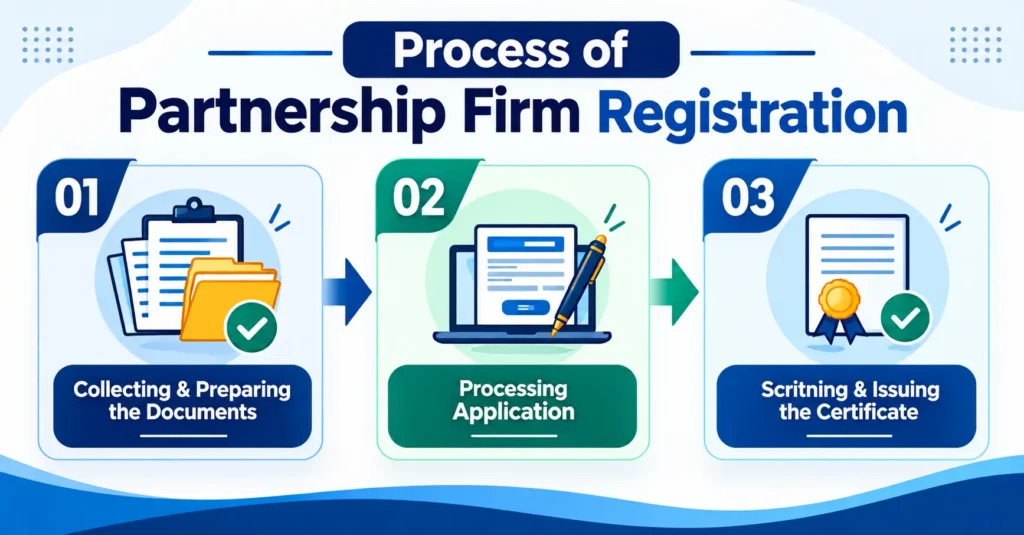
Process of Partnership Firm Registration