Shugam Best FSSAI License Consultant

MSME Registration

MSME Registration
Blogs

Documents Required for MSME Registration

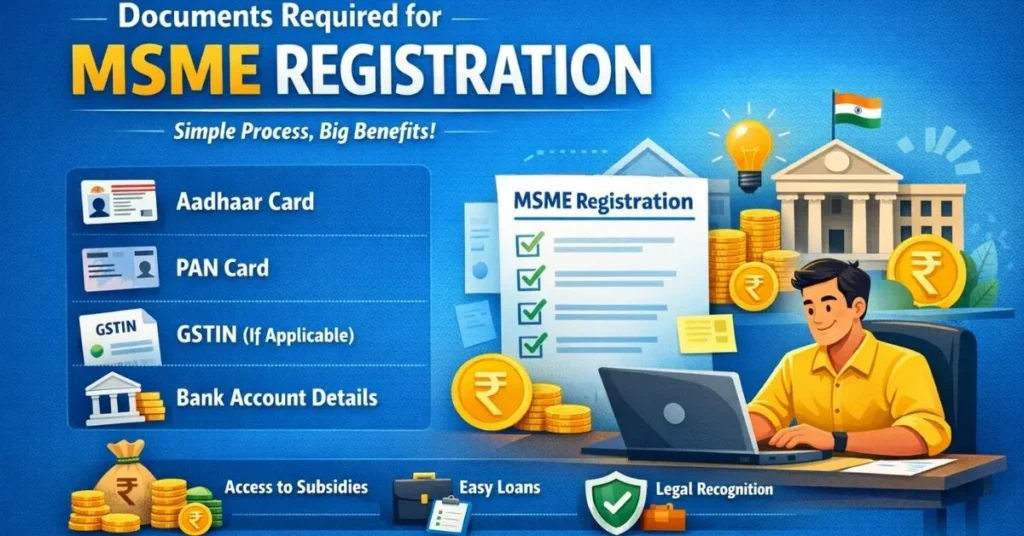
Starting a business is exciting, but paperwork can quickly drain that excitement. MSME/UDHYAM registration, officially known as Udyam Registration, makes life easier for entrepreneurs by offering legal recognition and access to government benefits. Still, one question comes up every time: what documents are required for MSME/UDHYAM registration? The good news is that the process is simple, fully online, and designed to reduce documentation stress. The government relies on digital verification instead of physical paperwork, which saves time and avoids unnecessary confusion. Understanding the exact documents required for MSME registration helps you prepare in advance, avoid errors, and complete the process smoothly. This introduction sets the foundation by explaining what you need, why it matters, and how proper documentation supports faster and hassle-free MSME certificate. What Is MSME (Udyam) Registration? MSME registration is a government-recognized identity for businesses under the Micro, Small, and Medium Enterprises Development (MSMED) Act, 2006. Since July 2020, the Ministry of MSME introduced Udyam Registration, which replaced the older Udyog Aadhaar system. The good news?The registration process is fully online, paperless, and free of cost. The better news?You don’t need a folder full of documents anymore. Why MSME Registration Matters Before jumping into documents, let’s address the obvious question: Why should you care? MSME CERTIFICATE helps businesses access: Collateral-free loans under government schemes Lower interest rates from banks Priority sector lending Protection against delayed payments Subsidies, tax benefits, and tender advantages In short, MSME registration builds financial credibility and legal trust. Documents Required for MSME Registration (Updated List) Here’s the truth many websites overcomplicate:MSME CERTIFICATE requires very limited documentation. The Indian government designed Udyam to reduce compliance stress, not increase it. 1. Aadhaar Card of the Applicant The Aadhaar number of the business owner is mandatory. Proprietorship: Owner’s Aadhaar Partnership: Managing partner’s Aadhaar Company / LLP: Authorized signatory’s Aadhaar The Aadhaar links directly with the UIDAI database for verification. You don’t upload a scanned copy; the system verifies it digitally. Source: Ministry of MSME – Udyam Registration Portal 2. PAN Card (Mandatory) PAN is compulsory for all MSMEs. Individual PAN for proprietorships Entity PAN for companies, LLPs, and partnerships The system fetches business details automatically from the Income Tax Department, which reduces errors and false claims. No PAN means no MSME/UDHYAM  registration. Simple. Source: Income Tax Department of India 3. GSTIN (If Applicable) GST registration is not mandatory for all MSMEs, but if your business is registered under GST, you must provide your GSTIN. The Udyam portal cross-verifies: Business turnover GST-linked activity If your business does not fall under GST requirements, you can proceed without it. Source: Central Board of Indirect Taxes and Customs (CBIC) 4. Business Bank Account Details You need basic bank information, such as: Bank account number IFSC code This helps the government link your MSME with financial institutions for loan schemes and subsidies. No cancelled cheque upload required. Digital verification does the heavy lifting. 5. Basic Business Information (No Physical Proof) Instead of physical documents, you provide self-declared details, including: Business name Type of organization Address of business activity Date of commencement Primary business activity (manufacturing or services) The portal relies on Aadhaar, PAN, and GST databases to verify accuracy. Yes, the government finally trusts entrepreneurs. Do You Need Investment or Turnover Proof? Short answer: No paperwork required. Long answer:The Udyam portal automatically pulls: Investment data from Income Tax records Turnover data from GST returns This removes the need for balance sheets, CA certificates, or invoices during registration. Source: MSMED Act & Udyam Notification, 2020 MSME Classification Criteria (For Clarity) While documents aren’t required, classification still matters: Micro Enterprise:Investment ≤ ₹1 crore and Turnover ≤ ₹5 crore Small Enterprise:Investment ≤ ₹10 crore and Turnover ≤ ₹50 crore Medium Enterprise:Investment ≤ ₹50 crore and Turnover ≤ ₹250 crore These limits are defined by the Government of India and remain publicly available. Common Mistakes to Avoid During MSME Registration Even with minimal documentation, mistakes happen. Avoid these: Entering incorrect Aadhaar or PAN details Using mismatched business names across records Skipping GST details when applicable Registering multiple Udyam numbers for one business One business equals one Udyam Registration. Google and the government both hate duplicates. Is UDHYAM Registration Really Free? Yes. Completely. Zero cost. If someone charges you “government fees,” run faster than your internet connection. The official portal does not charge any registration fee. Source: Official Udyam Registration Portal, Ministry of MSME Final Thoughts: Less Paper, More Progress MSME registration no longer feels like a test of patience. The Indian government has removed unnecessary paperwork and shifted toward trust-based digital verification. To recap, the documents required for MSME registration are mainly: Aadhaar PAN GSTIN (if applicable) Bank details If your goal is to build credibility, access funding, and grow legally, MSME registration is not optional anymore. It’s smart business.
Documents Required for MSME Registration Read Post »

MSME Registration
Blogs

MSME Registration | Udyam Registration for Businesses

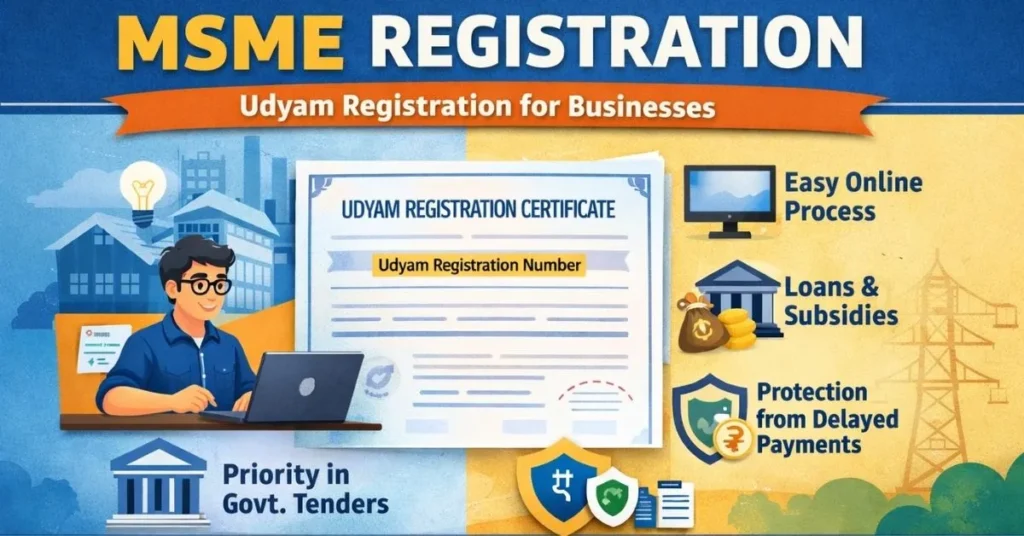
Starting and running a business in India takes courage, patience, and a lot of paperwork tolerance. While passion drives entrepreneurs, government recognition often opens the real doors. This is where MSME Registration, officially known as Udyam Registration, becomes important for businesses of all sizes. Udyam Registration is a simple online process introduced by the Government of India to formally recognise micro, small, and medium enterprises. It helps businesses gain access to financial support, government schemes, and legal protection without adding unnecessary complexity. More importantly, it creates trust, both with authorities and with customers, which every growing business needs. Whether you run a small shop, a service firm, or a manufacturing unit, MSME registration gives your business a structured identity in the Indian economy. It is not just a certificate. It is a practical step toward stability, credibility, and long-term growth. What Is MSME Registration (Udyam Registration)? MSME Registration is an online government registration introduced by the Ministry of Micro, Small and Medium Enterprises. It officially recognises businesses as Micro, Small, or Medium Enterprises. In July 2020, the Government of India replaced the old Udyog Aadhaar system with Udyam Registration. Since then, all MSMEs register through the official portal:https://udyamregistration.gov.in This registration is completely online, paperless, and free of cost. Yes, free. If someone asks you to pay the government fee, that is your first red flag. Once registered, your business receives a Udyam Registration Number and an e-certificate. Why MSME Registration Matters for Businesses Many entrepreneurs skip MSME registration because it looks optional. That logic sounds good until you need a loan, subsidy, or government tender. Here is the logic part. MSME registration acts as proof that your business exists in the MSME ecosystem. Banks, government departments, and public sector units trust this classification. Add to that a few benefits, and suddenly this “optional” step feels very necessary. Registered MSMEs get easier access to bank loans, priority sector lending, and lower interest rates under government-linked schemes. They also receive protection against delayed payments under the MSMED Act, which is a serious relief for small businesses dealing with late-paying clients. In simple words, MSME registration gives your business a louder and more official voice. MSME Classification Under Udyam Registration The government classifies MSMEs based on investment in plant and machinery or equipment and annual turnover. This classification applies equally to manufacturing and service businesses. A Micro Enterprise has limited investment and turnover. A Small Enterprise sits in the middle. A Medium Enterprise operates at a larger scale but still qualifies for MSME benefits. The government updates these limits officially, so businesses should always rely on current notifications available on the MSME Ministry website:https://msme.gov.in No self-declared guessing works here. The Udyam portal automatically pulls turnover data from GST and income tax systems where applicable. Who Can Apply for Udyam Registration? Almost any business type can apply. This includes proprietorships, partnerships, LLPs, private limited companies, Hindu Undivided Families, co-operative societies, trusts, and even self-help groups engaged in business activity. Manufacturing businesses qualify. Service providers qualify. Even freelancers offering professional services can qualify if they meet the criteria. One key rule matters here. Each PAN can register only one Udyam, but that Udyam can include multiple activities. Documents Required for MSME Registration Here is the refreshing part. No physical documents are uploaded. You only need: Aadhaar number of the proprietor or authorised signatory PAN of the business Basic business details like address and activity The portal verifies information through government databases. This reduces errors, fraud, and endless uploads. This approach also improves trust, which Google likes and businesses appreciate. Step-by-Step MSME Registration Process The Udyam Registration process stays simple and direct. You visit the official Udyam portal and select the registration option. You enter Aadhaar details and verify via OTP. After that, you add PAN and basic business information. The system auto-fetches investment and turnover data wherever available. Once you submit the form, the portal generates your Udyam Registration Certificate. Most registrations complete within minutes. No follow-up visits. No physical signatures. No chai-pani culture involved. Benefits of Udyam Registration for Businesses Let us talk real benefits, not exaggerated promises. Registered MSMEs get easier access to government schemes like credit guarantee programs and interest subsidies. Banks treat MSMEs as priority sector borrowers, which improves approval chances. MSMEs also receive preference in government tenders. Many tenders reserve a portion exclusively for MSMEs. Another major benefit is protection against delayed payments. If a buyer delays payment beyond the agreed time, MSMEs can legally charge interest under the MSMED Act. This provision alone saves many businesses from cash-flow nightmares. Add tax rebates, ISO certification subsidies, and support for technology upgrades, and the value becomes clear. Is MSME Registration Mandatory? No, MSME registration is not legally mandatory. But here is the honest truth. If you want government benefits, easier finance, or stronger credibility, skipping it makes little sense. Many private companies also prefer working with MSME-registered vendors. It signals seriousness, not size. Common Myths About MSME Registration One common myth says small turnover businesses do not need registration. That is incorrect. Size does not remove eligibility. Another myth claims MSME registration increases tax burden. It does not. Tax obligations depend on income tax and GST laws, not MSME status. Some believe renewal is required every year. Udyam registration does not need annual renewal, but businesses must update information if details change. Trusted Sources and Government References All information in this article is based on official government sources, including: Ministry of MSME: https://msme.gov.in Udyam Registration Portal: https://udyamregistration.gov.in MSMED Act, 2006 Final Thoughts MSME Registration | Udyam Registration for Businesses is not paperwork for the sake of formality. It is a practical step that adds structure, trust, and opportunity to your business. It costs nothing. It takes little time. And it delivers long-term value. If you are serious about growing your business the smart way, Udyam registration deserves a spot on your checklist. Sometimes, the smartest moves are also the simplest ones.

,

MSME Registration | Udyam Registration for Businesses Read Post »

Scroll to Top