
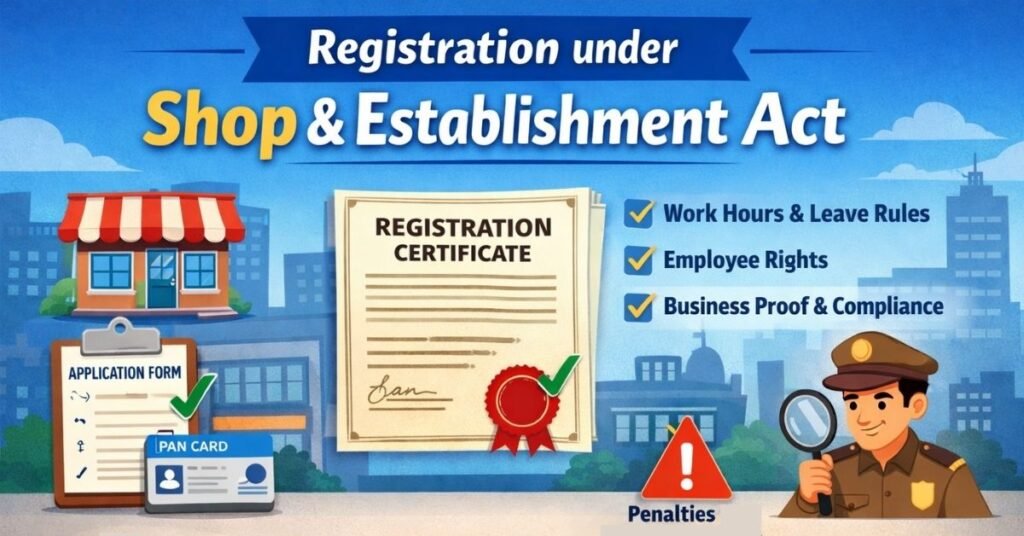
Registration under Shop and Establishment Act
Starting a business is exciting. Dealing with legal compliance? Not so much. Yet, every business in India—whether a small shop, a growing startup, or a professional office—must follow certain labour laws from day one. One of the most important among them is Registration under the Shop and Establishment Act. This registration acts as official proof that your business exists and follows state labour regulations. It defines working hours, employee rights, leave policies, and basic workplace conditions. In simple terms, it keeps both employers and employees on the same legal page. Ignoring it may save time today, but it often leads to penalties and compliance issues later. In this article, we break down everything you need to know about registration under the Shop and Establishment Act—who needs it, why it matters, how to apply, and what happens if you skip it. Clear facts, logical explanations, and no legal confusion—just what a business owner actually needs. What Is the Shop and Establishment Act? The Shop and Establishment Act is a state-specific labour law that regulates working conditions in commercial establishments. Each Indian state enforces its own version, but the core objective remains the same. This law governs: Working hours Weekly offs and holidays Salary payment rules Employment of women and young persons Leave policies Workplace safety and welfare The Act applies to shops, offices, commercial establishments, IT companies, co-working spaces, and service providers. Fact check: Labour laws in India fall under the Concurrent List, which allows states to frame their own rules.Source: Ministry of Labour & Employment, Government of India (labour.gov.in) Who Needs Registration under Shop and Establishment Act? If your business involves people and a place (physical or digital), the Act probably applies to you. You must register if you operate: Retail or wholesale shops Offices or corporate establishments Restaurants, cafés, hotels, and food outlets Salons, clinics, gyms, and coaching centres Startups and IT/ITES companies Freelance offices with employees Even home-based businesses with staff may require registration. Why Is Shop and Establishment Registration Important? Skipping registration may feel tempting. It is also risky. 1. Legal Compliance Registration keeps your business aligned with state labour laws. Non-compliance can trigger penalties or inspections. 2. Proof of Business Existence Banks, government departments, and vendors often ask for this certificate as official business proof. 3. Smooth Hiring Process The registration confirms that your employment practices follow the law. That builds trust with employees. 4. Required for Other Registrations You may need it for: GST registration MSME (Udyam) registration Opening a current bank account Documents Required for Shop and Establishment Act The document list stays fairly standard across states, with minor variations. You usually need: PAN card of the business or owner Address proof of establishment (rent agreement, utility bill) Identity proof of employer Details of employees Nature of business activity Some states also ask for: Partnership deed or incorporation certificate Digital signature Always verify requirements on your state labour department portal. Online Registration Process for Shop and Establishment Act Most states now offer online registration under Shop and Establishment Act, which saves time and sanity. Here’s how the process typically works: 1: Visit State Labour Portal Each state has a dedicated website under the Labour Department. 2: Create Login Register using your mobile number or email ID. 3: Fill Application Form Enter establishment details, employee count, and business activity. 4: Upload Documents Upload scanned copies in the prescribed format. 5: Pay Government Fees Fees depend on state rules and employee strength. 6: Receive Certificate After verification, the department issues a Shop and Establishment Registration Certificate. Processing time ranges from 1 to 15 working days, depending on the state. Validity and Renewal Rules This is where businesses often slip. Some states issue lifetime certificates Others require periodic renewal (1–10 years) Failing to renew on time can attract penalties. Example: Maharashtra now issues lifetime registration, while some states still follow renewal cycles.Source: State Labour Department notifications Penalties for Non-Compliance: Shop and Establishment Act The law does not enjoy being ignored. Possible consequences include: Monetary fines Legal notices Difficulty obtaining other licenses Issues during labour inspections The penalty amount varies by state and violation type. Humour break: Paying registration fees once is cheaper than paying fines repeatedly. The math always wins. Common Myths You Should Ignore 1: Small businesses don’t need registration.False. Size does not always exempt you. 2: Online businesses are exempt.Also false. Offices and employees trigger applicability. 3: No one checks this.Inspections happen, especially during GST or labour audits. Trusted Sources and Legal References To maintain transparency and trust, always rely on official portals: Ministry of Labour & Employment, Government of India(labour.gov.in) Final Thoughts Registration under Shop and Establishment Act is not just a legal formality. It is a foundation stone for running a compliant and professional business in India. The process has become simpler, faster, and mostly online. Ignoring it creates unnecessary risk. Completing it builds trust—with employees, banks, and the government.And honestly, ticking this legal box early lets you focus on what matters more—growing your business, not explaining it to inspectors.