Shugam Best FSSAI License Consultant

Author name: shugamnoida@gmail.com

FSSAI Registration Noida for food businesses
FSSAI Registration

What is FSSAI Registration Noida for Food Businesses and Why Is It Important?

FSSAI Registration Noida for food businesses. Noida is rapidly emerging as one of India’s most vibrant hubs for food businesses, ranging from small cafes and restaurants to large-scale food manufacturing units. With the booming food industry comes the responsibility to ensure safety, hygiene, and compliance with regulations. One of the most critical steps for entrepreneurs in the city is obtaining FSSAI Registration Noida for food businesses. This registration, issued by the Food Safety and Standards Authority of India (FSSAI), certifies that a food business adheres to the highest standards of food safety, ensuring consumers receive safe and high-quality products. Understanding FSSAI Registration Noida for Food Businesses FSSAI Registration Noida for food businesses is mandatory for all operators, regardless of their business size or type. The registration process falls under the Food Safety and Standards Act, 2006, which sets the legal framework for food safety across India. Once registered, a business receives a unique 14-digit FSSAI license or registration number, which must be displayed on food packaging, menus, or within the establishment. This number acts as proof of compliance with legal and hygiene standards. Key Benefits of FSSAI Registration Noida FSSAI Registration Noida offers several advantages for food businesses in India. It helps build consumer trust and credibility, as customers prefer products from registered and safe food operators. It provides legal protection, ensuring compliance with the Food Safety and Standards Act, 2006, and avoiding fines or penalties. Registered businesses can access larger markets, including retail chains, distributors, and online platforms that require FSSAI certification in Noida. Additionally, it promotes quality assurance by encouraging proper hygiene, safe handling, and standardized processes in production and storage. Overall, FSSAI Registration Noida not only ensures regulatory compliance but also strengthens brand reputation, customer confidence, and growth opportunities for food businesses. There are three main types of FSSAI Registration Noida for food businesses, based on business scale and turnover: Basic FSSAI Registration This is suitable for small-scale food businesses, such as home-based food makers, street vendors, and small cafés. It provides legal recognition and ensures compliance with basic food safety regulations. State FSSAI License Medium-sized businesses operating within Noida or Uttar Pradesh require a State FSSAI License. It is applicable to businesses with higher turnover than the threshold for basic registration and includes additional documentation and inspections. Central FSSAI License Large-scale food manufacturers, importers, exporters, or multi-state operators must obtain a Central FSSAI License. This license ensures compliance with national food safety standards and allows businesses to operate on a larger scale. Importance of FSSAI Registration Noida  Obtaining FSSAI Registration Noida for food businesses is more than a legal requirement—it offers significant advantages for entrepreneurs in the city: Consumer Trust and Credibility With rising consumer awareness about food safety, having an FSSAI registration number builds trust and assures customers that the food they consume meets high safety standards. This enhances brand credibility and encourages repeat business. Legal Protection Operating without proper registration can result in fines, legal penalties, or even business closure. FSSAI Registration ensures that food businesses comply with legal standards, safeguarding them from potential risks. Market Expansion Many retail chains, distributors, and online delivery platforms in Noida require suppliers to hold a valid FSSAI license. Registration allows businesses to access wider markets, expand partnerships, and explore growth opportunities. Quality Assurance FSSAI encourages proper hygiene practices, standardized production methods, and safe storage processes. This ensures consistent quality and builds consumer confidence in the brand. Step-by-Step Process for FSSAI Registration Noida  Obtaining registration in Noida is straightforward but requires proper documentation and planning: Determine Your Category Identify whether your business needs Basic Registration, State License, or Central License, based on turnover, business size, and operations. Prepare Documents Collect documents such as identity proof, business address, food safety management plan, and business constitution certificates. Application Submission Complete the online application on the FSSAI portal, upload documents, and pay the applicable registration fee. Inspection (if required) State and Central licenses may require a physical inspection to verify hygiene and compliance with safety standards. Receive License/Registration Number Once approved, FSSAI issues a 14-digit registration number valid for one to five years depending on the license type. This number must be displayed on products and premises. Common Misconceptions About FSSAI Registration Noida  Some food entrepreneurs think that only large businesses require registration, but even small-scale operators must register. Another misconception is that registration is permanent; licenses must be renewed periodically to remain valid. Conclusion about FSSAI Registration Noida for Food Businesses In Noida’s competitive food industry, FSSAI Registration Noida for food businesses is essential for legal compliance, consumer trust, and business growth. It enables businesses to operate safely, expand market reach, ensure quality assurance, and enhance credibility. Whether managing a small café or a multi-state food business, securing FSSAI Registration demonstrates professionalism, commitment to hygiene, and dedication to consumer safety.

, , , ,

What is FSSAI Registration Noida for Food Businesses and Why Is It Important? Read Post »
FSSAI Registration for food businesses
FSSAI Registration

What is FSSAI Registration and Why Is It Important for Food Businesses in India?

FSSAI Registration for food businesses. In India, the food industry is expanding rapidly, and food safety is a top priority. For every food business, whether small or large, compliance with government regulations is essential to ensure hygiene, quality, and consumer trust. One of the most important legal requirements for food business operators is FSSAI Registration. This registration, issued by the Food Safety and Standards Authority of India (FSSAI), certifies that a business adheres to food safety standards and regulations. Understanding FSSAI Registration for Food Businesses FSSAI Registration is a mandatory requirement for all food business operators in India. It ensures that food products meet the safety and hygiene standards defined under the Food Safety and Standards Act, 2006. Once a business completes the registration process, it receives a unique 14-digit FSSAI license or registration number that must be displayed on food packaging, menus, or the business premises. Key Benefits of FSSAI Registration for Food Businesses FSSAI Registration offers several advantages for food businesses in India. It helps build consumer trust and credibility, as customers prefer products from registered and safe food operators. It provides legal protection, ensuring compliance with the Food Safety and Standards Act, 2006, and avoiding fines or penalties. Registered businesses can access larger markets, including retail chains, distributors, and online platforms that require FSSAI certification. Additionally, it promotes quality assurance by encouraging proper hygiene, safe handling, and standardized processes in production and storage. Overall, FSSAI Registration not only ensures regulatory compliance but also strengthens brand reputation, customer confidence, and growth opportunities for food businesses. FSSAI Registration for food businesses is divided into three main categories based on business size and turnover: Basic FSSAI Registration This is designed for small-scale food businesses, such as home-based food producers, small restaurants, or petty shops with low annual turnover. It provides legal recognition to small food operators and ensures they meet basic food safety standards. State FSSAI License Medium-sized businesses operating within a single state require a State FSSAI License. It is applicable for businesses with a higher turnover than the threshold set for basic registration and involves more detailed documentation and compliance requirements. Central FSSAI License Large food businesses operating in multiple states or involved in the manufacturing of packaged food, imports, or exports require a Central FSSAI License. This license ensures compliance with nationwide food safety standards and enables businesses to operate on a larger scale. Importance of FSSAI Registration for Food Businesses FSSAI Registration is more than a legal formality; it offers multiple benefits to food businesses: Consumer Trust and Credibility A valid FSSAI registration number reassures consumers that the food they are purchasing meets safety and quality standards. This builds brand credibility and encourages repeat business. Legal Protection Operating without an FSSAI registration can lead to fines, penalties, or even closure of the business. Having a valid license protects your business from legal complications and ensures smooth operations. Market Expansion Many retail chains, distributors, and e-commerce platforms require suppliers to have FSSAI Registration. Registered businesses can access wider markets and attract partnerships that would otherwise be unavailable. Quality Assurance The FSSAI process encourages food businesses to maintain proper hygiene, follow safety protocols, and ensure quality control in production, storage, and distribution processes. Step-by-Step Process for FSSAI Registration for Food Businesses The process for obtaining FSSAI Registration is simple but requires proper planning and documentation. Determine Your Category Identify whether your business requires a Basic FSSAI Registration, State FSSAI License, or Central FSSAI License based on turnover, scale, and location of operations. Prepare Documents Collect necessary documents such as proof of identity, business address, food safety management plan, and business constitution documents to submit along with your application. Application Submission Fill out the application form on the FSSAI website, upload the required documents, and pay the applicable registration fee according to your business category. Inspection (if required) For State and Central licenses, FSSAI authorities may conduct a physical inspection of your premises to verify hygiene standards, equipment, and food handling practices. Receive License/Registration Number Upon successful verification and approval, FSSAI issues a 14-digit registration or license number valid for one to five years, depending on the type of registration. This number must be displayed prominently to comply with regulations. Common Misconceptions About FSSAI Registration for Food Businesses Many food business owners assume that FSSAI Registration is only needed for large-scale manufacturers. In reality, even small businesses, home-based food vendors, and street food operators must register. Another common misconception is that registration is a one-time process; in fact, FSSAI licenses must be renewed periodically to remain valid. Conclusion about FSSAI Registration for Food Businesses In today’s competitive food industry, FSSAI Registration is essential for legal compliance, consumer trust, and business growth. It provides credibility, legal protection, access to larger markets, and ensures that food products meet safety standards. Whether operating a small bakery or a large multi-state food business, obtaining FSSAI Registration demonstrates a commitment to quality, hygiene, and customer satisfaction. By following the registration steps carefully and maintaining compliance, food business owners can operate confidently while protecting their brand and customers.

,

What is FSSAI Registration and Why Is It Important for Food Businesses in India? Read Post »

Apeda Certificate Registration
APEDA, Spice Board & Export Promotion, Blogs

Apeda Certificate Registration

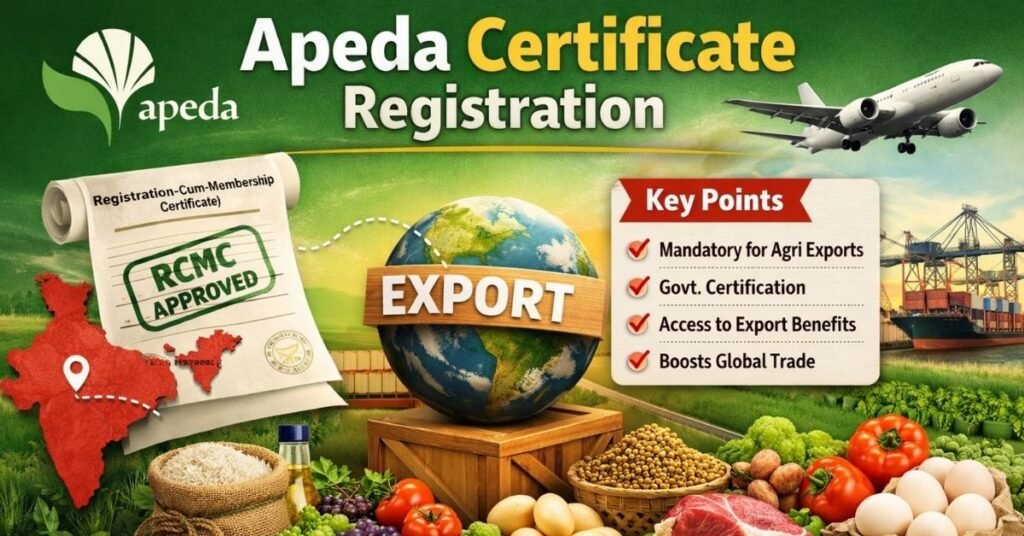
Exporting agricultural and processed food products from India offers massive opportunities, but it also demands strict compliance with government regulations. One of the most important legal requirements in this process is the Apeda Certificate Registration. Without it, exporters cannot legally ship APEDA-scheduled products outside India, no matter how strong their buyer network is. APEDA, a statutory authority under the Ministry of Commerce and Industry, plays a key role in regulating and promoting India’s agri-exports. Its registration system ensures that exporters meet quality standards, follow traceability norms, and align with global trade expectations. This structure protects buyers, supports exporters, and strengthens India’s reputation in international markets. What Is APEDA and Why Does It Exist? APEDA stands for the Agricultural and Processed Food Products Export Development Authority. The Government of India established it under the APEDA Act, 1985, and it works under the Ministry of Commerce and Industry. APEDA’s role is simple but powerful. It regulates, promotes, and develops the export of scheduled agricultural and processed food products from India. It also sets quality standards and helps Indian exporters build global credibility. In short, APEDA acts as a bridge between Indian exporters and international markets. Trusted source: APEDA is a statutory body created by an Act of Parliament (APEDA Act, 1985), which makes it a legally authoritative institution. What Is Apeda Certificate Registration? Apeda Certificate Registration is the official process through which an exporter registers with APEDA and receives a Registration-cum-Membership Certificate (RCMC). This certificate proves that: You are a recognised exporter Your products fall under APEDA’s scheduled categories You comply with Indian export regulations Without this certificate, you cannot legally export APEDA-listed products from India. Think of it as a passport for your export business. Who Needs APEDA Registration? You need Apeda Certificate Registration if you export or plan to export any product listed under APEDA’s schedule. These include: Fruits and vegetables Processed foods Meat and meat products Poultry products Dairy products Cereals and cereal products Honey Floriculture products If your product appears on APEDA’s official list, registration is mandatory. There is no workaround. Even one export shipment requires it. Benefits of Apeda Certificate Registration APEDA registration is not just about compliance. It offers real business value. 1. Legal Export Eligibility APEDA registration allows you to export legally. Customs authorities may reject shipments without a valid RCMC. 2. Access to Government Schemes Registered exporters can access APEDA’s export promotion schemes, infrastructure support, and training programs. 3. International Trust Global buyers prefer APEDA-registered exporters. The certificate signals credibility and regulatory compliance. 4. Market Development Support APEDA helps exporters participate in international trade fairs, buyer-seller meets, and export promotion events. In simple terms, APEDA registration builds both legal safety and market trust. Documents Required for Apeda Certificate Registration The registration process stays document-driven. You must keep everything accurate and updated. Required documents include: Import Export Code (IEC) issued by DGFT PAN card of the business Bank certificate or cancelled cheque Address proof of business premises Digital signature certificate Details of products for export All information must match your IEC and PAN records. Even small errors can delay approval. Trusted source: IEC is issued by the Directorate General of Foreign Trade (DGFT), another statutory authority under the Ministry of Commerce. Step-by-Step Apeda Certificate Registration Process The registration process happens online through APEDA’s official portal.  1: Create an Account Visit the APEDA portal and create an exporter login using your IEC details.  2: Fill the Application Form Enter business details, product categories, and contact information carefully.  3: Upload Documents Upload scanned copies of the required documents in the prescribed format.  4: Pay Registration Fee Pay the registration fee online. APEDA follows a transparent government fee structure.  5: Verification and Approval APEDA verifies your details. Once approved, you receive your RCMC electronically. The process usually completes within a few working days if the documents are accurate. Validity and Renewal of APEDA Certificate Apeda Certificate Registration does not last forever. The RCMC remains valid for five financial years Renewal is required before expiry to avoid export disruptions Late renewal can lead to shipment delays, scheme ineligibility, and compliance issues. Exporters should track validity carefully. Common Mistakes Exporters Make (And How to Avoid Them) Even experienced exporters make small mistakes during APEDA registration. Common issues include: Mismatch between IEC and PAN details Uploading unclear documents Selecting incorrect product categories Ignoring certificate renewal deadlines A simple rule helps: cross-check everything before submission. Accuracy saves time, money, and stress. How APEDA Supports Export Quality and Safety APEDA not only register exporters. It also promotes quality. The authority works closely with: Food safety regulators Testing laboratories Export inspection agencies APEDA also supports traceability systems, residue monitoring, and quality certification programs. These steps help Indian exporters meet international food safety standards. This focus on quality improves India’s export reputation globally. Trusted Sources and Legal References This article is based on information from: APEDA (Agricultural and Processed Food Products Export Development Authority) – Government of India APEDA Act, 1985 Ministry of Commerce and Industry Directorate General of Foreign Trade (DGFT) These are statutory and authoritative government sources, ensuring accuracy and reliability. Final Thoughts Apeda Certificate Registration is not paperwork for the sake of paperwork. It is a legal requirement, a trust signal, and a growth enabler for exporters. If you plan to export agricultural or processed food products, APEDA registration should be your first step. Done correctly, it protects your business, builds buyer confidence, and opens doors to global markets. Export smart. Register right. And let compliance work for you, not against you.

Apeda Certificate Registration Read Post »

FSSAI Export Import License
Blogs

FSSAI Export Import License

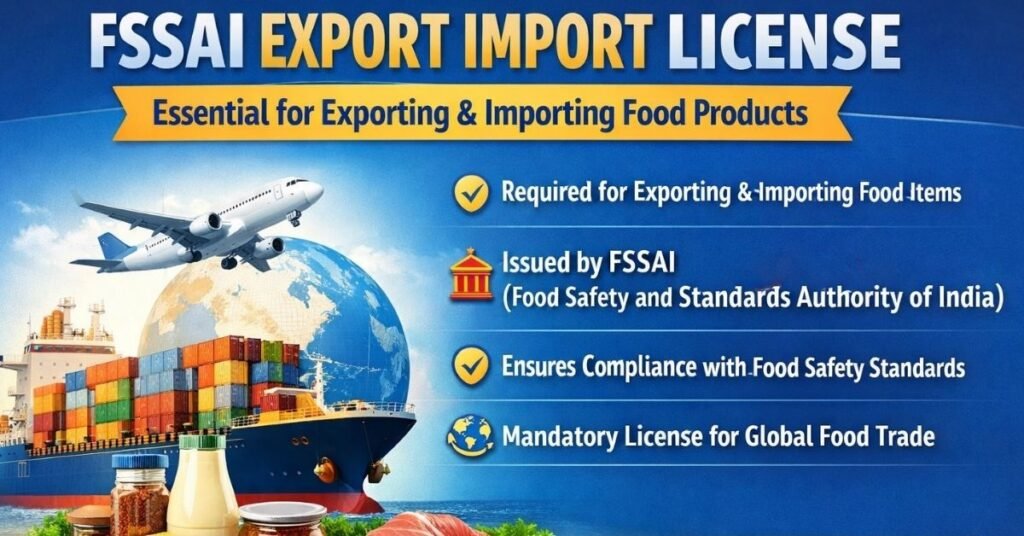
The global food trade looks exciting from the outside, but behind every smooth export or import lies strict regulation and careful compliance. In India, food businesses cannot step into international markets without meeting food safety rules defined by law. This is where the FSSAI Export-Import License becomes essential. It acts as legal proof that the food being sent out of India or brought into the country meets prescribed safety and quality standards. Without this license, even a perfectly packed shipment can stop at customs. For exporters and importers, understanding this requirement early saves time, money, and unnecessary stress, while also building long-term trust in global trade. What Is an FSSAI Export Import License? The FSSAI Export Import License is a Central FSSAI License issued by the Food Safety and Standards Authority of India. It allows food businesses to legally export food items from India or import food products into India. FSSAI regulates food safety under the Food Safety and Standards Act, 2006. For export and import, the law requires stricter compliance because food crosses borders and affects international consumers. In simple words, if your food travels outside India or enters India from another country, FSSAI wants proof that it is safe, traceable, and compliant with Indian food laws. Is the FSSAI Export Import License Mandatory? Yes, it is mandatory.Any food business involved in exporting or importing food must hold a Central FSSAI License with Export-Import endorsement. Customs authorities verify this license before clearing food consignments. This requirement applies even if you already hold a State or Basic FSSAI Registration. Those licenses work only for domestic trade. Export and import fall under central jurisdiction. According to FSSAI and Indian Customs guidelines, food consignments without valid FSSAI licensing can face rejection, re-export, or destruction. Who Needs an FSSAI Export Import License? You need this license if you fall into any of these categories: Food exporters sending packaged or processed food outside India Food importers bringing food items into India Manufacturers exporting their own branded food products Traders importing food for resale or distribution E-commerce sellers shipping food internationally Even small businesses and startups must comply. FSSAI does not give exemptions based on company size when it comes to food safety. Difference Between FSSAI Export Import License and IEC This part often confuses people, so let’s clear it logically. The IEC (Import Export Code) is issued by the Directorate General of Foreign Trade (DGFT). It allows you to participate in international trade. The FSSAI Export Import License focuses only on food safety compliance. You need both. Think of IEC as your passport to trade and FSSAI as your health clearance. One without the other does not work for food products. Products Covered Under FSSAI Export Import License FSSAI covers almost all food categories, including: Packaged food items Processed foods Dairy products Meat and seafood Spices and condiments Health supplements and nutraceuticals Beverages, alcoholic and non-alcoholic FSSAI checks labeling, ingredients, additives, shelf life, and hygiene standards. This protects both Indian consumers and India’s reputation in global markets. Documents Required for FSSAI Export-Import License The documentation process remains transparent and structured. FSSAI asks for documents that prove identity, location, and food safety responsibility. You usually need: Company or firm registration proof Import Export Code issued by DGFT Address proof of business premises List of food products for export or import Authority letter and identity proof of responsible person Food safety management plan declaration FSSAI may ask for additional details depending on product category. This ensures risk-based regulation instead of random approvals. How to Apply for FSSAI Export Import License The application process happens online through the FoSCoS portal, which replaced the older FLRS system. You start by selecting a Central License and choosing export or import activity. After uploading documents, you pay the government fee and submit the application. FSSAI officials review the details. In some cases, they may ask for clarification. Once approved, the license gets issued with a unique 14-digit FSSAI number. The process follows standard timelines defined by FSSAI, making it predictable and transparent. Validity and Renewal of the License The FSSAI Export Import License remains valid for one to five years, based on the option you choose during application. Renewal must happen before expiry. Late renewal attracts penalties and may disrupt shipments. Smart exporters renew early, because customs systems sync with FSSAI databases. Why This License Builds Trust and Business Growth This license does more than satisfy a legal requirement. It builds trust with international buyers who expect regulatory compliance. It improves clearance speed at ports and airports. It reduces the risk of shipment rejection and financial loss. It shows commitment to global food safety standards. Countries importing Indian food often rely on FSSAI certification as a baseline. A valid license strengthens India’s credibility in global food trade. Common Mistakes Businesses Should Avoid Many delays happen because of simple mistakes. Applying under the wrong license categoryMismatch between IEC details and FSSAI recordsIncomplete product listsIgnoring renewal deadlines Avoid shortcuts. Food regulations reward accuracy, not speed. Trusted Authorities Behind FSSAI Export Import Licensing This system operates under well-defined government bodies: Food Safety and Standards Authority of India (FSSAI) Ministry of Health and Family Welfare Directorate General of Foreign Trade (DGFT) Indian Customs and Port Health Officers These authorities follow published regulations and standard operating procedures. That is why businesses should rely only on official compliance paths instead of assumptions. Final Thoughts The FSSAI Export Import License is not paperwork for the sake of paperwork. It exists to protect consumers, businesses, and India’s global food image.If your business touches international food trade, this license becomes your legal and ethical foundation. When you treat it seriously, trade becomes smoother, safer, and more profitable.In food export and import, trust travels faster than containers. FSSAI helps you deliver both.

FSSAI Export Import License Read Post »

Import Export Code Registration
Blogs

Import Export Code Registration

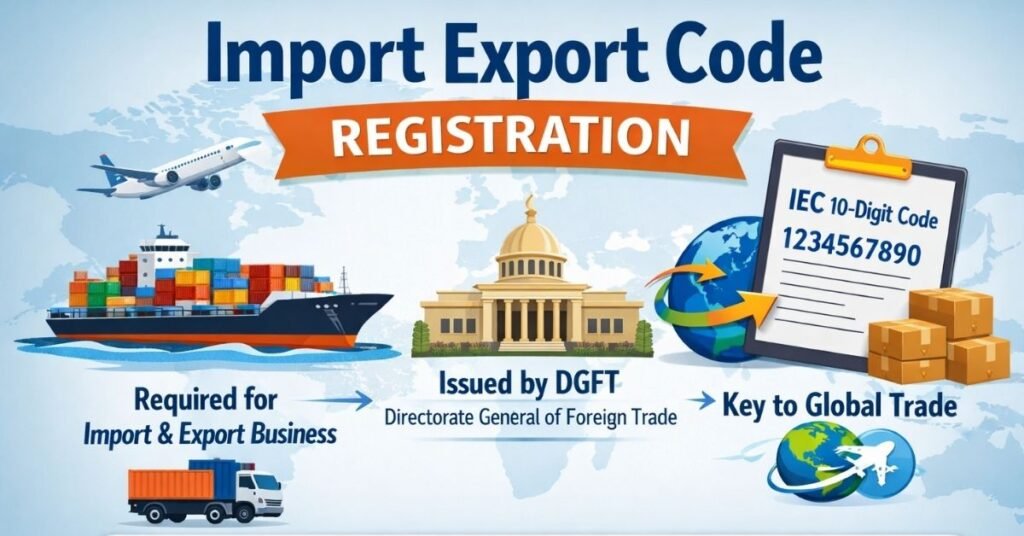
Import Export Code registration stands at the heart of every successful international trade journey in India. Whether you plan to ship handmade products to Europe or import machinery from China, the government requires one simple but powerful number before anything moves across borders — the IEC. This ten-digit code, issued by the Directorate General of Foreign Trade (DGFT), works like a business passport. Without it, customs authorities won’t clear goods, and banks won’t process foreign payments. In today’s globally connected economy, even small businesses sell beyond national boundaries. E-commerce platforms, digital payments, and global logistics have made cross-border trade easier than ever. However, legal compliance still decides who can trade and who must sit on the sidelines. IEC registration ensures that your business plays by the rules while enjoying access to international markets. What Is an Import Export Code (IEC)? In easy terms, Import Export Code (IEC) is like a passport for your business in the world of global trade. In India, it’s a unique 10-digit code issued by the Directorate General of Foreign Trade (DGFT), Ministry of Commerce and Industry. Without it, you can’t legally import or export goods or services to and from India for business purposes. Think of IEC as your business identity in international trade. Banks, customs authorities, and government agencies use it to verify your legitimacy before clearing shipments or allowing foreign currency transactions. Importantly, after GST was introduced, the IEC number is now linked to your PAN. This means a single PAN gets treated as your IEC number after registration. Who Needs Import Export Code Registration? Here’s the simple rule: If you are importing or exporting goods or services for commercial purposes, you need an IEC. Individuals, proprietorships, partnerships, LLPs, private limited companies, trusts, HUFs, and societies can all apply. There are a few exceptions where IEC is not mandatory: Personal imports or exports (non-commercial) Indian Government departments Notified charitable organisations GST-registered traders in certain cases (PAN suffices) In short, if you’re serious about international trade as a business, don’t skip IEC — it’s central to eligibility and compliance. Why Import Export Code Registration Matters Before you think of it as “just another government code”, consider this: What’s the point of trading internationally without a valid ID? IEC helps in: Legal Compliance Customs authorities won’t clear your goods without it. Banks won’t allow foreign remittances without your IEC. Market Access IEC unlocks global markets. With it, you can import raw materials or export finished products worldwide. Government Schemes & Benefits Exporters with IEC can avail benefits under DGFT schemes like duty drawbacks, export subsidies, and export promotion council assistance. Credibility For banks and clients abroad, an IEC number signals professionalism and legitimacy. No code, no trust. Step-by-Step: How to Register for an Import Export Code Here’s the real deal — how to get IEC in practical terms: 1. Register on the DGFT Portal First, create your profile on the official DGFT portal (https://dgft.gov.in). Provide valid contact details, PAN, and email/mobile number. You’ll receive login credentials and an OTP verification. 2. Login & Apply for IEC Once logged in, choose “Apply for IEC” under the IEC profile section. Accurate information matters — a simple typo in PAN, name, or address can delay your application. 3. Fill Application Form ANF 2A This is the official application form. Here, you’ll enter your PAN, entity name, address, bank account details, and contact information. 4. Upload Required Documents You only need scanned copies of approved documents — no fizzy paperwork or postal delays. Typical items include: PAN card Cancelled cheque or bank certificate Proof of address (rent deed, electricity bill, etc.) Aadhar/ID proof of directors or owners 5. Pay Government Fee There is a one-time government fee of ₹500. That’s it. No monthly returns or hidden charges from DGFT. 6. Submit & Track Your Application After submission, DGFT verifies the form. You’ll get your IEC via email in about 7–15 working days, provided all documents and details are correct. Once approved, your IEC is valid for life — no renewal required. That’s a welcome break from most registrations that like to call every year for updates! Key Documents Required Here’s a checklist you should not forget: Entity Type Core Documents Needed Proprietor PAN, Aadhaar, cancelled cheque, ID proof, address proof Partnership/LLP PAN of entity, partnership deed, partner ID proofs Company Incorporation certificate, director ID proofs, PAN All Bank account proof in the entity’s name, email, phone Pro tip: Keep file sizes small (PDF) and file names clear. This reduces upload errors. Common Mistakes to Avoid:Import Export Code Registration Here are things that make many applicants scratch their heads:  Using an old or mismatched email PAN and bank account names not matching Wrong address proofs Filling old forms — only ANF 2A is accepted Ignoring OTP timeouts on DGFT portal Being human-error proof goes a long way here. Import Export Code Registration: FAQs Is IEC mandatory for trading between India and Nepal/Bhutan?Yes, if it’s commercial. Customs everywhere treat IEC as the first ID check. Do I need a digital signature?Not for IEC — only genuine PAN authenticated digital entry is enough. Can I add branches?Yes — one IEC number can have multiple branch addresses. Does IEC expire?No, once issued, it lasts the lifetime of your business unless canceled. Final Thoughts IEC registration might sound bureaucratic at first, but in reality, it’s one of the simplest and most rewarding steps to launch your international trade journey. With a ₹500 fee, online form, and minimal paperwork, you get a lifetime code that opens doors to global markets and business credibility. That’s value you won’t get from many government registrations!Remember: correct details, neat documents, and patience are your friends here. Once IEC is in hand, you’ll feel like a global business owner- because, well, you will be one!

Import Export Code Registration Read Post »

Trade Mark Registration
Blogs, How-To Guides & Business Tips

How to Get Trade Mark Registration

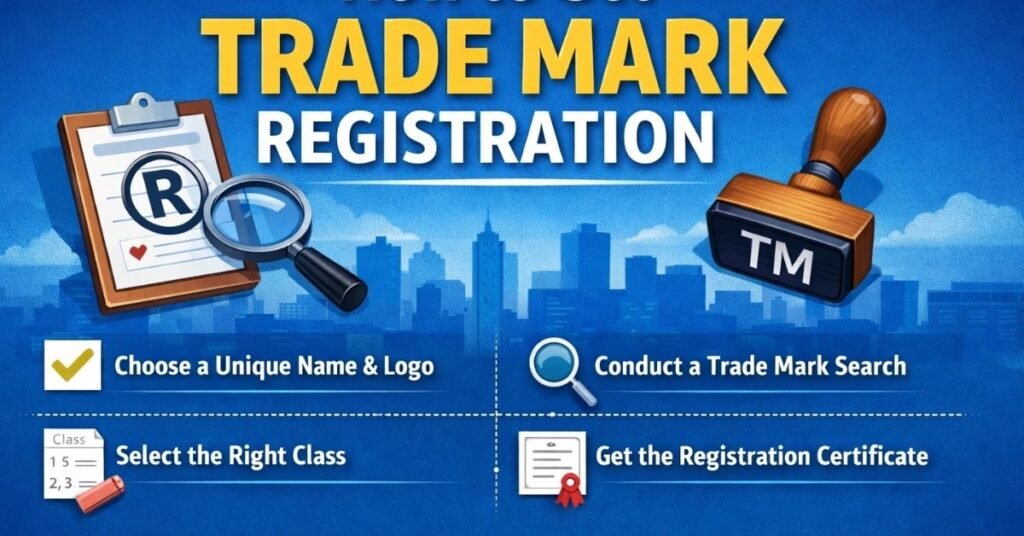
Building a brand takes effort, creativity, and more than a few late nights. Choosing a name, designing a logo, and earning customer trust all feel rewarding—until someone else starts using something confusingly similar. That’s where trade mark registration becomes essential. It legally protects your brand identity and ensures that the recognition you earn stays yours. If you’re wondering how to get trade mark registration, you’re not alone. Many businesses delay this step because the process sounds complicated or overly legal. In reality, it follows a clear structure when you understand the rules. This guide breaks the process down into simple, practical steps, using verified information and real-world logic, so you can protect your brand with confidence and clarity. What Is a Trade Mark and Why Does It Matter? A trade mark is a legal identity for your brand. It can be a name, logo, slogan, symbol, or even a sound in some cases. Once registered, it gives you exclusive rights to use that mark for specific goods or services. Why does this matter? It prevents others from copying your brand. It builds customer trust It adds real business value It helps in legal enforcement if disputes arise According to the World Intellectual Property Organization (WIPO), trademarks play a key role in consumer protection and fair competition. That’s not legal drama—that’s basic brand survival. Who Can Apply for Trade Mark Registration? Almost anyone involved in business can apply. This includes: Individuals Startups Sole proprietors Partnership firms LLPs Private Limited Companies NGOs and Trusts You don’t need a registered company to apply. Even an idea backed by genuine business intent qualifies. Yes, even freelancers and small sellers on Instagram can register a trade mark. Brand protection is not just for big companies with fancy offices. 1: Choose a Strong and Registrable Trade Mark Not all names deserve legal protection. Some get rejected faster than spam emails. A strong trade mark should be: Unique and distinctive Easy to pronounce and remember Not descriptive (e.g., “Best Shoes” for footwear) Not identical or similar to existing trademarks Avoid generic words. Avoid copying competitors. Avoid trouble. Pro tip: Invented or arbitrary words (like Google or Zomato) usually have a higher approval rate. 2: Conduct a Trade Mark Search (Don’t Skip This) Before filing, conduct a trade mark search on the official IP India public search portal. This step checks whether a similar mark already exists. Skipping this step is like proposing without checking if the person is already married. Awkward and expensive. A proper search reduces: Objections Legal disputes Application rejection You can do it yourself or take professional help if the mark is critical to your business. 3: Identify the Correct Trade Mark Class Trade marks are registered under 45 classes, based on goods and services. This classification system follows the Nice Classification, used globally. Examples:  Class 25: Clothing and footwear Class 35: Advertising and marketing services Class 43: Restaurants and food services Choose the correct class. A wrong class can weaken your legal protection. If your business operates in multiple categories, you can apply under multiple classes. 4: File the Trade Mark Application Now comes the official part. You can file the application: Online via the IP India website Offline at designated Trade Marks Registry offices Required details include: Applicant name and address Trade mark representation (word/logo) Applicable class Date of first use (if already in use) Once filed, you receive an application number. From this moment, you can legally use the ™ symbol. That small symbol sends a big message: “This brand is serious.” 5: Examination by the Trade Marks Office After filing, the application goes for examination. A Trade Mark Examiner reviews it for: Legal compliance Similarity with existing marks Distinctiveness If everything looks fine, the mark moves forward.If not, the examiner issues an examination report with objections. Don’t panic. Objections are common and manageable. 6: Reply to Objections (If Any) If objections arise, you must respond within 30 days. Your reply should: Clarify legal points Explain brand uniqueness Include supporting documents if needed Clear reasoning and proper drafting make a big difference here. Many applications fail not because the mark is weak, but because the reply is poorly written. Logic beats emotion every time. 7: Publication in the Trade Marks Journal Once objections are resolved, the trade mark gets published in the Trade Marks Journal. This allows the public to raise opposition. The opposition period lasts 4 months. If no one objects, congratulations—you’re almost there. 8: Registration and Certificate Issuance If no opposition is filed, or if opposition is resolved in your favour, the Trade Marks Registry issues a Registration Certificate. Now you can use the ® symbol. Your trade mark remains valid for 10 years and can be renewed indefinitely. Yes, your brand can outlive you. That’s the power of registration. Trusted Sources and Legal Framework This article follows information from: Office of the Controller General of Patents, Designs & Trade Marks (IP India) World Intellectual Property Organization (WIPO) Trade Marks Act, 1999 (India) Final Thoughts: Is Trade Mark Registration Worth It? Yes,Trade mark registration protects your brand identity, supports business growth, and builds long-term trust. It’s not a luxury. It’s a smart business move.If you’re investing time, money, and creativity into a brand, protecting it is just logical. After all, common sense is the best legal strategy.

How to Get Trade Mark Registration Read Post »

Scroll to Top