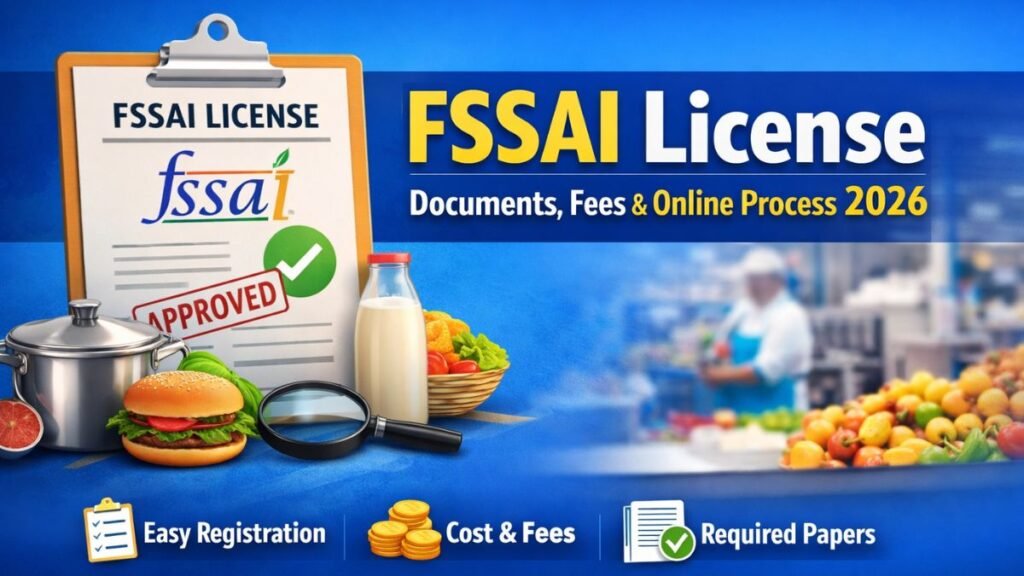
FSSAI License | Documents, Fees & Online Process 2026
FSSAI License: Imagine you’ve just opened your dream cloud kitchen or food startup. Orders are coming in, customers are happy… and then suddenly someone asks, “Do you have an FSSAI license?” Awkward silence. This is a very common situation in India. Many food business owners focus on taste, branding, and delivery—but forget one crucial thing: legal compliance. An FSSAI License is not just a legal formality. It’s your business identity in the food industry. It tells customers that your food is safe, hygienic, and trustworthy. In this guide, we’ll break everything down in simple terms—no jargon, no confusion. Just clear, practical information you can actually use. What is FSSAI License? An FSSAI License is a mandatory registration issued by the Food Safety and Standards Authority of India under the Food Safety and Standards Act, 2006. It is required for any business involved in: Manufacturing food Processing food Packaging food Storing food Distributing or selling food Think of it like a “permission slip” from the government that says your food business follows proper safety and hygiene standards. Without this license, running a food business in India is illegal. Why is FSSAI License Important? 1. Legal Requirement If you are dealing with food in any way, you must have an FSSAI license. Operating without it can lead to penalties or even closure. 2. Builds Customer Trust Customers feel safer ordering from businesses that display an FSSAI number. It shows professionalism and credibility. 3. Helps in Business Growth Want to list your products on platforms like Swiggy, Zomato, or Amazon?You’ll need an FSSAI license. 4. Ensures Food Safety The license ensures that your business follows hygiene and safety standards, reducing risks of contamination. 5. Easy Expansion Planning to scale your business or export food products?FSSAI registration becomes your foundation. Who Needs an FSSAI License? If your business is even remotely connected to food, you likely need it. Here’s a quick breakdown: Restaurants and cafes Cloud kitchens and home kitchens Food delivery businesses Food manufacturers and processors Bakeries and confectionery shops Dairy and milk units Food importers and exporters Grocery stores and supermarkets Street food vendors Simple rule: If you sell food, you need FSSAI. Types of FSSAI License FSSAI offers three types of licenses based on your business size and turnover: 1. Basic FSSAI Registration For small businesses and startups Ideal for home kitchens and small vendors 2. State FSSAI License For medium-sized businesses Required when operations expand within a state 3. Central FSSAI License For large businesses Required for import/export or operations across multiple states Choosing the correct type is important. Applying for the wrong one can delay your approval (and nobody likes paperwork delays!). Documents Required for FSSAI License Here are the commonly required documents: PAN card of the business owner Aadhaar card or ID proof Passport-size photograph Business address proof (rent agreement or electricity bill) Food safety management plan List of food products Business registration proof (if applicable) NOC from municipality (in some cases) Tip: Keep all documents clear and updated. Blurry uploads are a silent enemy of approvals. Fees & Validity The cost of an FSSAI license depends on: Type of license (Basic, State, Central) Nature of business Scale of operations Duration selected Validity: Minimum: 1 year Maximum: 5 years Longer validity can save renewal effort later, so choose wisely. Step-by-Step Process to Apply for FSSAI License Here’s a simplified process anyone can follow: Step 1: Determine License Type Identify whether you need a Basic, State, or Central license. Step 2: Prepare Documents Gather all required documents beforehand. Step 3: Apply Online Submit your application through the official FSSAI portal. Step 4: Application Review Authorities will review your application and documents. Step 5: Inspection (if required) In some cases, a food safety officer may inspect your premises. Step 6: License Approval Once approved, you’ll receive your FSSAI license number. Benefits of FSSAI License Legal Protection You stay compliant with Indian food laws. Brand Trust Customers trust businesses with proper certification. Better Market Reach You can sell on online platforms and expand your business. Business Credibility It improves your brand image in front of partners and investors. Competitive Advantage Many small vendors skip compliance—this is your chance to stand out. Common Mistakes to Avoid Let’s save you from some classic mistakes: Choosing the Wrong License Type Many businesses apply for the wrong category. This leads to rejection or delays. Incomplete Documentation Missing documents = application stuck. Ignoring Renewal Dates Expired license = legal trouble. Incorrect Business Details Even small errors can cause rejection. Treating It as “Optional.” It’s not optional. It’s mandatory. Think of FSSAI like your driving license. You can drive without it… But you really shouldn’t. How Shugam Consultants Can Help Applying for an FSSAI license may look simple, but small errors can cause delays or rejection. That’s where Shugam Consultants steps in. We help food businesses across India with: Correct license selection Document preparation Error-free application filing Quick processing support End-to-end online service Our goal is simple: make compliance easy so you can focus on growing your business. Conclusion An FSSAI License is not just a regulatory requirement—it’s a foundation for a successful food business. It ensures: Legal safety Customer trust Business growth If you’re serious about running a food business in India, getting an FSSAI license should be your first step. Don’t wait until someone asks for it. Get it before they do. Trusted Sources 1. FSSAI Licensing Official Page This is the official licensing section of the Food Safety and Standards Authority of India Confirms that every Food Business Operator must obtain FSSAI license under the Food Safety & Standards Act, 2006 2. FSSAI Official Website (Apply for License) Official government portal for FSSAI registration and license application (FoSCoS system) Provides the latest updates, regulations, and application access 3. FSSAI Registration Guidelines Page Explains who needs registration vs license based on business size Clearly states that all food businesses must be registered/licensed under FSSAI
FSSAI License | Documents, Fees & Online Process 2026 Read Post »