Export Import License | Check Fees, Documents & Benefits
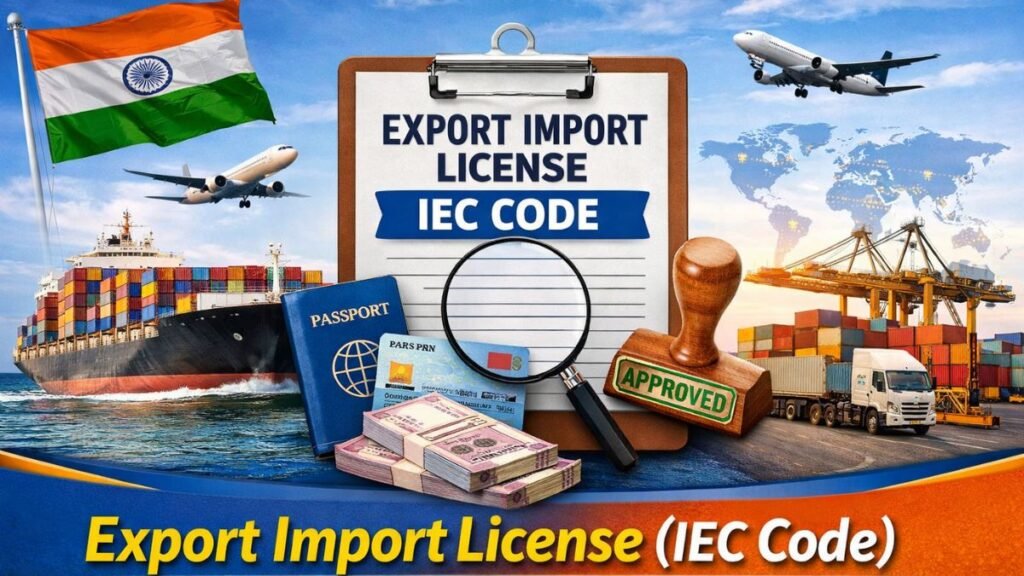
Export Import License: Imagine this: you’ve finally found a buyer from Dubai for your products. Excitement is high… until someone asks, “Do you have an Export-Import License?” Suddenly, things pause. This is a very common situation for Indian business owners. Many entrepreneurs are ready to grow globally, but get stuck at compliance. The Export Import License, also known as the IEC Code, is the first step to enter international trade legally. If you want to import goods or export your products outside India, this license is not optional—it’s mandatory. In this guide, we’ll break everything down in simple language so you can understand what it is, why it matters, and how to get it without confusion. What is Export-Import License? The Export Import License in India is officially called the Import Export Code (IEC). It is issued by the Directorate General of Foreign Trade, which works under the Ministry of Commerce and Industry. In simple terms: IEC is a 10-digit code required for any business involved in importing or exporting goods or services from India. Without this code: You cannot export goods You cannot import products Banks won’t process international transactions Think of IEC as your passport for global trade. Why is Export-Import License Important? 1. Legal Requirement If you want to do import-export business in India, IEC is mandatory. No IEC = no international trade. 2. Smooth Customs Clearance Customs authorities require IEC during shipment clearance. Without it, your goods can get stuck (and no one likes that kind of “international delay”). 3. Easy International Payments Banks need IEC to process foreign currency transactions. It ensures your payments are tracked and compliant. 4. Access to Government Benefits Exporters can get benefits under schemes promoted by DGFT and Agricultural and Processed Food Products Export Development Authority. 5. Builds Business Credibility Having an IEC makes your business look professional and trustworthy to global buyers. Who Needs Export-Import License? If you fall into any of these categories, you need an IEC: Manufacturers exporting goods Traders importing products E-commerce sellers selling internationally Service providers dealing with foreign clients Startups planning global expansion Freelancers receiving international payments Even if you’re a small business, once you cross borders, IEC becomes essential. Types of Export-Import License in India Unlike other licenses, IEC is quite simple. There are no complicated categories, but usage differs based on your business: 1. IEC for Businesses Issued to companies, LLPs, or proprietorships for import/export activities. 2. IEC for Individuals Freelancers or individuals receiving payments from abroad may also need IEC in some cases. 3. Special Registrations (Optional) Some industries may require additional registrations along with IEC, such as: APEDA (for food exports) FSSAI (for food businesses) RCMC (Registration Cum Membership Certificate) Documents Required for IEC Code The documentation process is simple and fully online. Here’s what you typically need: PAN Card (Individual or Business) Aadhaar Card or identity proof Business address proof Bank account details (cancelled cheque or bank certificate) Passport-size photograph (if applicable) Digital signature (for companies/LLPs) Good news: No physical paperwork or office visits required. Fees & Validity of Export-Import License Fees The government fee for IEC is minimal. However, the total cost may vary depending on: Professional assistance (if you take expert help) Type of business entity Documentation complexity Validity Here’s the best part: IEC comes with lifetime validity. No renewal is required. But you must update details annually on the DGFT portal to keep it active. Step-by-Step Process to Apply for Export-Import License Let’s keep it simple and practical. Step 1: Visit DGFT Portal Go to the official DGFT website and create your account. Step 2: Fill out the IEC Application Enter business details like: Name Address PAN Bank details Step 3: Upload Documents Upload scanned copies of the required documents. Step 4: Pay Application Fee Make the payment online. Step 5: Verification DGFT verifies your details digitally. Step 6: Get IEC Code Once approved, your IEC is generated instantly in most cases. Yes, it’s that quick if everything is correct. Benefits of Export-Import License 1. Expand Globally You can sell your products worldwide and grow beyond local markets. 2. Easy Import of Raw Materials Get better quality or cheaper materials from international suppliers. 3. Government Incentives Exporters may receive incentives under government schemes. 4. Business Growth Global markets = bigger opportunities = higher profits. 5. No Compliance Burden Unlike many licenses, IEC doesn’t require frequent filings. Common Mistakes to Avoid Even though the process is simple, people still make mistakes. Wrong Details in Application Incorrect PAN or bank details can delay approval. Not Updating IEC Annually DGFT requires yearly updates. Ignoring this can deactivate your IEC. Assuming IEC is Enough Some industries need additional registrations (like FSSAI or APEDA). DIY Without Understanding Trying to “figure it out” at midnight usually leads to errors (and frustration). A small mistake can delay your international plans—so be careful. How Shugam Consultants Can Help Applying for an Export-Import License may look simple, but small errors can create big delays. That’s where Shugam Consultants comes in. We help you: Apply for IEC quickly and correctly Avoid common mistakes Handle documentation smoothly Get expert guidance for export-related registrations Our process is 100% online, fast, and designed for busy entrepreneurs. So you focus on growing your business—we handle the paperwork. Conclusion Starting an import-export business sounds exciting—and it truly is. But before you ship your first product or receive your first international payment, you need the right foundation. The Export Import License (IEC) is the foundation. It is simple to obtain, valid for a lifetime, and essential for global trade. If you’re planning to grow beyond India, don’t delay this step. Because in business, opportunities don’t wait—and neither should you. Trusted Sources 1. Directorate General of Foreign Trade (DGFT)As per the Directorate General of Foreign Trade (Ministry of Commerce & Industry, Government of India), obtaining an Import Export Code (IEC) is mandatory for businesses involved in import and export activities in India. 3. Vikaspedia (Government Initiative)As explained by Vikaspedia, IEC registration is
Export Import License | Check Fees, Documents & Benefits Read Post »